
Resin Flooring Malaysia: Complete Guide to Epoxy, Polyurethane, Industrial Resin Floors, Prices & Installation
Industrial and commercial floors must withstand more than ordinary foot traffic. In factories, warehouses, production facilities, commercial kitchens and workshops, flooring systems may be exposed to heavy equipment, chemical spills, abrasion, moisture and frequent cleaning.
Traditional concrete flooring can perform well under suitable conditions, but some facilities require additional surface protection to improve durability, hygiene, chemical resistance and maintenance.
This is where resin flooring Malaysia solutions become relevant.
Resin flooring refers to flooring systems made from polymer-based materials, commonly including epoxy and polyurethane formulations. These materials are applied over prepared substrates to form protective coatings, self-leveling surfaces or thicker industrial flooring systems.
Depending on the formulation and installation method, resin flooring can provide a seamless finish, improved abrasion resistance, easier cleaning and specialised performance characteristics.
However, not every resin flooring system is suitable for every environment.
A warehouse with forklift traffic may require a different specification from a food-processing facility exposed to hot-water cleaning. Likewise, an electronics factory may require electrostatic discharge control, while a chemical-processing area may need specialised chemical resistance.
This guide explains the main resin flooring systems available in Malaysia, their applications, advantages, limitations, installation process, cost factors and maintenance requirements.
What Is Resin Flooring?
Resin flooring is a floor finishing or protection system that uses synthetic resin materials to create a bonded surface over a suitable substrate, typically concrete.
The resin is mixed and applied according to its formulation. It then cures to form a protective flooring layer.
Depending on the system, the finished floor may be thin, thick, smooth, textured, flexible or designed for specific industrial conditions.
Common resin flooring categories include:
-
Epoxy floor coating
-
Self-leveling epoxy flooring
-
Epoxy mortar flooring
-
Polyurethane flooring
-
Polyurethane concrete flooring
-
Anti-slip resin flooring
-
Chemical-resistant resin flooring
-
ESD and anti-static flooring
-
Decorative resin flooring
-
Resin floor resurfacing systems
The appropriate choice depends on expected traffic, exposure conditions, substrate quality and operational requirements.
Why Resin Flooring Is Popular in Malaysia
Resin flooring is commonly considered for industrial and commercial facilities because it can provide performance characteristics that untreated concrete may not offer.
1. Improved Surface Protection
Suitable resin systems protect concrete from certain types of abrasion, spills and surface deterioration.
2. Seamless Appearance
Many resin flooring systems can create a continuous finish with fewer joints than conventional tiled flooring.
Existing structural and movement joints still require appropriate treatment.
3. Easier Cleaning
A properly installed resin floor can provide a relatively smooth, non-porous surface that is easier to clean than damaged or highly porous concrete.
4. Chemical Resistance
Specialised resin systems can resist exposure to selected chemicals.
Resistance depends on the chemical, concentration, temperature and contact duration.
5. Different Surface Finishes
Resin floors can be specified with smooth, textured, decorative or slip-resistant finishes.
6. Suitability for Industrial Operations
Heavy-duty systems may be designed for warehouses, production facilities and areas exposed to industrial traffic.
Types of Resin Flooring Systems in Malaysia
1. Epoxy Resin Flooring
Epoxy resin flooring is widely used for industrial and commercial floor protection.
Epoxy systems generally consist of resin and hardener components that react to form a durable coating or flooring layer.
Common applications include:
-
Warehouses
-
Factories
-
Workshops
-
Commercial premises
-
Car parks
-
Storage facilities
-
Production areas
Epoxy flooring Malaysia is available in different thicknesses and performance grades.
Thin epoxy paint systems should not be confused with thicker, heavy-duty epoxy screeds.
2. Self-Leveling Epoxy Flooring
Self-leveling epoxy is designed to create a relatively smooth and uniform surface when applied over a properly prepared substrate.
It is often considered for:
-
Manufacturing facilities
-
Laboratories
-
Clean production areas
-
Pharmaceutical-related environments
-
Commercial facilities
The finished floor’s flatness depends on the existing substrate, application thickness and installation quality.
The term self-leveling does not mean the material can correct unlimited floor unevenness.
3. Polyurethane Resin Flooring
Polyurethane resin flooring is available in various formulations with different flexibility and chemical-resistance characteristics.
Certain polyurethane systems are suitable for environments where movement or specific exposure conditions make them preferable to conventional rigid coatings.
Potential applications include commercial, industrial and selected production areas.
Product specifications must be reviewed carefully because polyurethane coatings and polyurethane concrete systems are not interchangeable.
4. Polyurethane Concrete Flooring
Polyurethane concrete, also known as PU concrete or polyurethane cement flooring, combines polyurethane chemistry with cementitious and aggregate components.
It is commonly considered for demanding industrial environments.
Typical applications include:
-
Food-processing facilities
-
Commercial kitchens
-
Beverage production
-
Wet production areas
-
Industrial washdown zones
-
Facilities with temperature fluctuations
Some PU concrete systems are designed for thermal shock and aggressive cleaning conditions.
Actual performance depends on the specified product and thickness.
5. Epoxy Mortar Flooring
Epoxy mortar flooring incorporates aggregates to create a thicker, more robust flooring system.
It may be suitable for areas requiring improved impact or mechanical resistance.
Correct substrate preparation and installation are essential.
6. Anti-Slip Resin Flooring
Anti-slip resin flooring incorporates textured finishes or suitable aggregates to improve slip resistance.
It is often considered for:
-
Wet production areas
-
Loading zones
-
Ramps
-
Commercial kitchens
-
Industrial walkways
Slip resistance must be matched to the environment, cleaning regime and footwear conditions.
7. ESD and Anti-Static Resin Flooring
Electrostatic discharge flooring is designed to manage static electricity under specified conditions.
It may be required in:
-
Electronics manufacturing
-
Certain laboratories
-
Sensitive equipment areas
-
Selected production facilities
ESD performance depends on the complete flooring system, including primers, conductive layers, grounding arrangements and testing.
An ordinary epoxy coating should not be assumed to provide ESD protection.
8. Decorative Resin Flooring
Decorative resin flooring can provide coloured, flake, quartz or other finishes for commercial and selected residential environments.
Appearance, slip resistance and UV stability should be considered when selecting the system.
Epoxy vs Polyurethane vs PU Concrete Flooring
| Feature | Epoxy flooring | Polyurethane flooring | PU concrete flooring |
|---|---|---|---|
| Main material | Epoxy resin | Polyurethane resin | Polyurethane-cement composite |
| Typical application | Factories, warehouses, commercial floors | Selected industrial and commercial areas | Food processing and demanding industrial areas |
| Surface finish | Smooth or textured | Smooth or textured | Smooth or textured |
| Flexibility | Generally relatively rigid | Formulation-dependent | Formulation-dependent |
| Chemical resistance | Product-specific | Product-specific | Product-specific |
| Thermal shock resistance | Depends on system | Depends on system | Certain systems designed for demanding thermal conditions |
| Installation thickness | Thin coating to thick screed | Varies by product | Typically thicker industrial systems |
| Best selection basis | Mechanical and chemical requirements | Exposure and flexibility requirements | Wet processing and demanding operational conditions |
There is no single best resin flooring system for every project.
The correct choice depends on the facility’s operating conditions.
Where Is Resin Flooring Used in Malaysia?
Factory Resin Flooring
Manufacturing facilities often require floors capable of handling equipment, production traffic and routine cleaning.
Suitable resin systems can provide surface protection and a defined finish.
Warehouse Resin Flooring
Warehouses may experience forklift traffic, pallet movement and abrasion.
The specification should consider wheel loads, traffic intensity and the condition of the concrete slab.
Food Processing Facilities
Food production environments may require flooring systems compatible with frequent cleaning, wet conditions and temperature changes.
PU concrete is often considered for demanding applications.
Commercial Kitchens
Kitchen floors require attention to cleaning, drainage and slip resistance.
The selected resin system should be compatible with the expected exposure.
Automotive Workshops
Automotive facilities may need floors resistant to selected oils, lubricants and cleaning chemicals.
Chemical resistance should be verified against the intended substances.
Pharmaceutical and Laboratory Facilities
These environments may require smooth, cleanable surfaces and carefully controlled installation details.
Specific regulatory or operational requirements must be assessed separately.
Electronics Manufacturing
Some electronics facilities require tested ESD flooring systems.
Grounding and electrical resistance performance must meet the relevant project specifications.
Commercial Buildings
Resin flooring can also be considered for showrooms, service areas, corridors and selected car parks.
Resin Flooring Thickness: How Much Is Required?
Flooring thickness is an important specification because different systems provide different performance characteristics.
The following ranges are illustrative, not universal product specifications.
| Resin flooring type | Illustrative thickness range | Typical purpose |
|---|---|---|
| Thin epoxy coating | Approximately 0.2–0.5 mm | Light-duty surface protection |
| High-build epoxy coating | Approximately 0.5–1 mm | Increased coating build |
| Self-leveling epoxy | Approximately 1–3 mm | Smooth industrial finish |
| Epoxy mortar or screed | Approximately 3–6 mm or more | Heavy-duty applications |
| PU concrete | Approximately 4–9 mm or more | Demanding industrial conditions |
Actual thickness should follow the manufacturer’s technical data sheet and the project’s mechanical, chemical and thermal requirements.
A thicker system is not automatically the correct solution if the underlying concrete is weak or damaged.
Resin Flooring Installation Process
Step 1: Site Inspection
The contractor assesses the existing floor, including cracks, surface contamination, moisture and signs of deterioration.
Step 2: Substrate Testing
Relevant testing may include moisture assessment, surface strength and other checks required by the flooring specification.
Step 3: Surface Preparation
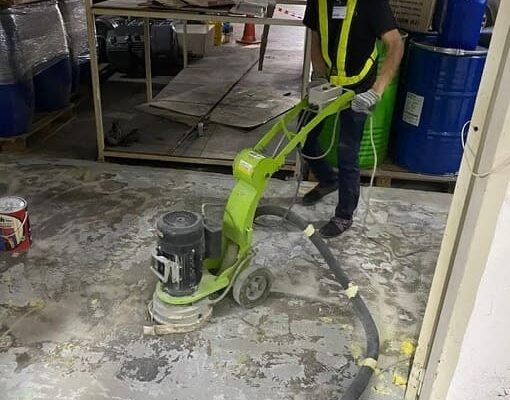
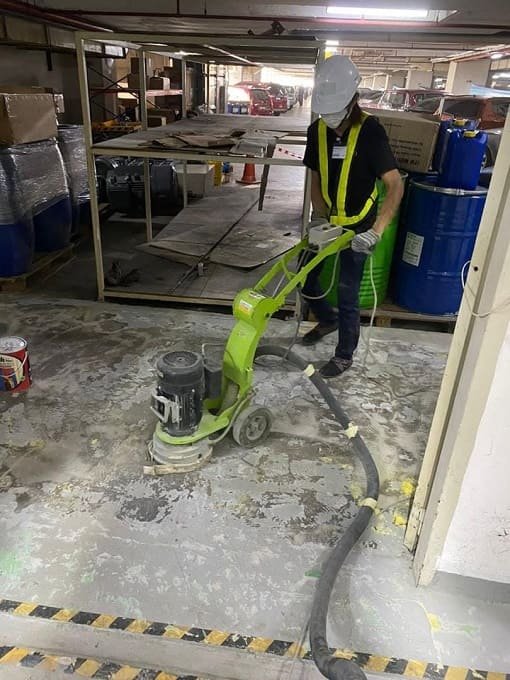
Mechanical grinding, shot blasting or other suitable preparation methods are used to remove weak surface material and establish the required surface profile.
Step 4: Concrete Repair
Cracks, damaged joints and defective concrete are repaired using compatible materials.
Active structural movement requires appropriate assessment.
Step 5: Primer Application
A compatible primer may be applied to improve bonding or address specified substrate conditions.
Step 6: Resin Flooring Application
The selected coating, self-leveling resin, screed or PU concrete system is installed according to the product requirements.
Step 7: Surface Finishing
The required smooth, textured or aggregate finish is formed.
Step 8: Curing
The floor is allowed to cure before pedestrian traffic, equipment movement or chemical exposure.
Step 9: Quality Inspection
The completed flooring is inspected for visible defects and any specified performance requirements.
Common Resin Flooring Problems
Peeling or Delamination
Possible causes include inadequate surface preparation, weak concrete, moisture or incompatible materials.
Blistering
Blisters may result from moisture, trapped air, application conditions or other substrate-related factors.
Cracking
Cracks may originate from the concrete substrate or movement joints.
A resin layer does not automatically eliminate underlying structural movement.
Discolouration
Some resin systems can change colour under UV exposure or chemical contact.
Slippery Surfaces
Smooth resin finishes may become slippery under wet or contaminated conditions.
A suitable slip-resistant finish should be specified where needed.
Premature Wear
Heavy traffic, unsuitable system thickness or abrasive conditions can accelerate surface deterioration.
Resin Flooring Price Malaysia: What Affects the Cost?
The price of resin flooring in Malaysia depends on the flooring system, substrate condition and project requirements.
| Cost factor | Effect on price |
|---|---|
| Floor area | Affects material quantities and labour |
| Resin type | Epoxy, polyurethane and PU concrete differ in cost |
| System thickness | Thicker systems generally require more material |
| Surface preparation | Grinding and shot blasting add work |
| Concrete repair | Cracks and damaged areas require treatment |
| Moisture condition | May require specialist preparation or barriers |
| Anti-slip finish | Additional aggregates and application steps |
| Chemical resistance | Specialist formulations may cost more |
| ESD requirements | Conductive layers, grounding and testing |
| Access and downtime | Installation scheduling affects labour and logistics |
How Much Does Resin Flooring Cost Per Square Foot?
There is no single reliable price per square foot that applies to every resin flooring project.
A thin epoxy coating for a lightly used storage area is not directly comparable to a thick PU concrete system for a food-processing facility.
Similarly, a new concrete slab with a sound surface may require less preparation than an old factory floor with damaged joints and contaminated concrete.
For accurate pricing, request a quotation specifying the system, thickness, preparation method and performance requirements.
How to Choose a Resin Flooring Contractor Malaysia
Check Relevant Experience
Choose a contractor familiar with the intended flooring system and facility type.
Review Material Specifications
Ask for the proposed product’s technical data sheet and recommended application thickness.
Assess Surface Preparation
A durable resin floor depends heavily on the quality of the substrate.
Confirm Chemical and Mechanical Requirements
The contractor should understand traffic loads, chemical exposure, cleaning procedures and operating temperatures.
Ask About Downtime
Confirm when the floor can safely receive pedestrian traffic, equipment and full operational loading.
Review the Quotation
Check whether concrete repairs, preparation, primer, resin layers, joint treatment and testing are included.
Understand Warranty Terms
If a warranty is offered, review its conditions, limitations and exclusions.
Resin Flooring Selangor and Kuala Lumpur
Resin flooring requirements are relevant to industrial and commercial properties throughout the Klang Valley.
Potential project locations include:
-
Shah Alam
-
Klang
-
Petaling Jaya
-
Subang Jaya
-
Puchong
-
Seri Kembangan
-
Kajang
-
Bangi
-
Rawang
-
Kuala Lumpur
Industrial facilities in these areas may require epoxy coatings, heavy-duty resin flooring, PU concrete or floor resurfacing.
The correct system depends on operational requirements, and contractor availability should be confirmed for the specific site.
Bumi Bina – Industrial Resin Flooring Services Malaysia
Bumi Bina Resources (M) Sdn. Bhd. is a Malaysian construction and specialist flooring service provider based in Seri Kembangan, Selangor.
Its published industrial flooring services include epoxy coatings, self-leveling epoxy, polyurethane-cement screeds, dry-shake hardeners, liquid hardeners and related flooring systems.
The company also lists concrete repair and other construction services that may be relevant when preparing damaged industrial floors.
Resin Flooring Services to Enquire About
Factory owners, warehouse operators and commercial property managers can discuss:
-
Epoxy floor coating
-
Self-leveling epoxy flooring
-
Polyurethane-cement flooring
-
Industrial floor resurfacing
-
Concrete floor repair
-
Protective floor coatings
-
Heavy-duty industrial flooring requirements
Specific material availability, technical specifications and project suitability should be confirmed directly.
Contact Bumi Bina
Company: Bumi Bina Resources (M) Sdn. Bhd.
Address: 23-1, Jalan PUJ 3/9, Taman Puncak Jalil, 43300 Seri Kembangan, Selangor, Malaysia.
Phone: 012-684 6079 (En. Suhaimi)
Website: https://bumibina.com
Need resin flooring for a factory, warehouse or commercial property? Contact Bumi Bina to discuss the existing floor condition, operating requirements and suitable flooring systems.
Resin Flooring Maintenance Tips
Proper maintenance helps protect the flooring system and identify developing defects.
-
Clean spills promptly using compatible methods.
-
Use cleaning chemicals approved for the selected resin system.
-
Remove abrasive dirt and debris regularly.
-
Inspect floor joints and cracks.
-
Avoid dragging sharp or heavy objects across the surface.
-
Use suitable protection beneath equipment where necessary.
-
Repair damaged areas before deterioration spreads.
-
Follow the flooring manufacturer’s maintenance instructions.
-
Monitor wear in high-traffic areas.
The cleaning method should match the floor’s chemical resistance and surface texture.
FAQ: Resin Flooring Malaysia
– 1. What is resin flooring?
Resin flooring is a protective or decorative floor system made from polymer-based materials such as epoxy or polyurethane, applied over a suitable substrate.
– 2. How much does resin flooring cost in Malaysia?
Costs depend on resin type, system thickness, floor area, substrate condition and performance requirements. A site-specific quotation is recommended.
– 3. Is epoxy flooring the same as resin flooring?
Epoxy flooring is one type of resin flooring. Other types include polyurethane and polyurethane concrete systems.
– 4. Which resin flooring is best for factories?
The best system depends on equipment loads, traffic, chemical exposure and cleaning requirements. Epoxy and PU concrete are among the systems commonly considered.
– 5. Is resin flooring suitable for warehouses?
Yes, suitable industrial resin flooring systems can be specified for warehouse environments, subject to the expected traffic and concrete condition.
– 6. What is the difference between epoxy and polyurethane flooring?
They use different resin chemistries and have different performance characteristics. Selection depends on the specific formulation and application.
– 7. Is resin flooring waterproof?
Many properly installed resin systems resist liquid penetration, but the ability to function as a complete waterproofing system depends on the product, thickness, joints and substrate conditions.
– 8. Can resin flooring be installed over old concrete?
Yes, if the existing concrete is suitable after assessment, preparation and necessary repairs.
– 9. How long does resin flooring installation take?
The duration depends on floor area, preparation, number of layers, environmental conditions and curing requirements.
– 10. Does Bumi Bina provide resin flooring services in Malaysia?
Bumi Bina lists epoxy coating, self-leveling epoxy and polyurethane-cement screeds among its industrial flooring systems. Contact the company to confirm the appropriate solution for your project.
Conclusion
Resin flooring Malaysia solutions offer a range of options for protecting and finishing industrial and commercial concrete floors.
Epoxy coatings, self-leveling epoxy, polyurethane flooring and PU concrete systems each provide different performance characteristics.
Choosing the correct system requires careful consideration of traffic, chemical exposure, cleaning methods, operating temperature, slip resistance and substrate condition.
Proper surface preparation, application thickness and curing are essential for achieving the intended performance.
For factories, warehouses, commercial kitchens, workshops and other facilities, professional assessment can help determine whether the project requires a protective coating, self-leveling finish or heavy-duty industrial flooring system.
Looking for resin flooring installation in Malaysia? Contact Bumi Bina at 012-684 6079 to discuss your factory, warehouse or commercial flooring requirements.
Call Us Now Your
Resin Flooring Malaysia Specialist Contractor 012–6846079 (Dato Suhaimi)
